On to Vanillaware: A Burning Desire to “Get Better at Drawing”
After you left Capcom, did you go straight to Vanillaware?
Nishimura:
No. My health was in bad shape, so I rested for a while. At first I was hoping to get into something like a CG commercial-production company. I’d come to realize that video work and animation were my strengths. But I took their hiring tests and failed completely.
On top of that, at that point I also had a strong desire of my own.
A desire — meaning?
Nishimura:
I wanted to get better at drawing.
During my Capcom years, I’d been drifting further and further toward CG — pixel art, polygons, that whole direction. So I had this nagging sense that my drawing ability itself had stayed weak.
On the Monster Hunter team there was a character artist named Kanbe, who was an absurdly good draftsman. It was a kind of frustration — I found myself wanting to be able to draw much better.
So you wanted to hone your craft as a creator, in a purer way.
Nishimura:
Right around then, a friend told me Vanillaware was hiring. This is it, I thought.
At the interview, the ones who showed up were George Kamitani and Shigatake, is that right?
(Shigatake — an illustrator at Vanillaware. One of the studio’s founding members, with the company since its Puraguru days, he has worked on nearly all of its titles.)
Nishimura:
That’s right. When I told them I’d been making Monster Hunter at Capcom, they were delighted. Though there was also a bit of a “why would you ever come somewhere like this?” air to it (he laughs ruefully).
I’d seen the artwork Vanillaware used in their job ad and thought, this is good — seriously amazing work. And on top of that, they were offering to let me draw. I had no confidence in my own art, so it was very much an “if you’ll take me, yes please” situation. I think Kamitani was glad to have me, too.
By the time you joined Vanillaware, were they already working on Odin Sphere?
Nishimura:
That’s right. Odin Sphere had about three stages of backgrounds finished — a forest, a wasteland, and a snowy mountain. Back then Shigatake was making the backgrounds, but there were few character artists.
After I came on, I took the lead on backgrounds, and Shigatake shifted over to characters and monsters.
As an aside — Odin Sphere is really full of clever touches that come precisely from being made by such a small team, isn’t it?
Nishimura:
The team was extremely small, yes. Resources were limited, too. It was mostly story-driven, structured so that motivation carried you through the stretches in between.
What do you feel you gained at Vanillaware?
Nishimura:
Truly — it’s the company that granted the very thing I’d wished for: getting better at drawing.
On a large-scale production, the slice you’re responsible for keeps getting narrower and narrower. My last job at Capcom was around the time of Devil May Cry 3, and I’d drifted into a supervisory role — handing out tasks to people and managing them. Once that happens, you can’t draw backgrounds anymore.
What I wanted most was to make the art itself.
I just had this drive to create, to express something. But inside a big company, you keep drifting away from that.
Vanillaware had so few people that there was no room to call yourself a “supervisor.” It was simply: make it, draw it. So I really did get to draw, constantly. And that made me happy.
The Man Called George Kamitani: If told “It’s Not Fun,” He Takes the Hit — and Fixes It
There’s no talking about a company like Vanillaware without talking about George Kamitani. From where you stood, what kind of person was he?
Nishimura:
Kamitani is, when it comes down to it, someone who carries Capcom’s bloodline. He holds a clear answer in his hands: “If it isn’t fun, it’s meaningless.” He worked with this tremendous will never to ship something until it was truly fun.
It was true of the art, and of the games too: he puts out the very best he’s capable of within his current potential. He won’t compromise — he tries to work at the highest possible standard.
So every time, he ends up tightening the noose around our own necks (laughs).
But each project pushed further than the last, and the next title further still — that’s how things kept moving forward. And our drawing improved along with it.
“We won’t ship it unless it’s fun” — plenty of people say that out loud. But in Kamitani’s case, left unchecked, he’ll really keep going until the company would collapse. There’s a genuine seriousness to it — a kind of madness, even.
Nishimura:
That’s right. Above all, he’s a remarkably receptive, unguarded person. Normally, when someone tells you “this part isn’t fun,” you might make excuses, or fire back with theory.
But in Kamitani’s case, he properly takes the hit — and then afterward, he properly fixes it.
That’s fascinating to hear.
Nishimura:
It might be better if he didn’t let it get to him, but I think that’s just how much he’s staking his life on it.
He takes the hit, and then he properly changes things. He’ll change the direction, too. Wherever something can be changed, he changes it. That receptiveness — I thought it was remarkable.
The public image of Kamitani tends to be of someone who has this grand vision — the worldbuilding is like this, the art is like that — and slams it all down fully formed. But when you actually talk to him, a lot of stories come out about how he isn’t keeping tight control of the floor by himself. Like the staff just go off and build things on their own. That’s very interesting to me.
Nishimura:
It’s true that Kamitani has an incredible vision.
But the parts in between — those, we on our side often fill in. We’d all think about “what do we do here,” and there were places we’d just go ahead and do without consulting Kamitani.
Going ahead without consulting him — is that really all right?
Nishimura:
He properly takes it in.
For instance, on Dragon’s Crown, Kamitani told me, “Make lots of dungeons.” But with nothing but stone walls, the art just wouldn’t come alive, no matter what.
So I’d build the outside scenery, saying, “Well, this is the forest before you enter the dungeon.”
I’ve actually heard that story from Kamitani himself.
Nishimura:
Before long, Kamitani said to me, “Nishimura, you have no intention of making dungeons, do you?” (laughs). “Ah, busted,” I thought — and kept making them anyway.
But in the end, Kamitani added a setting where there’s an entrance to the labyrinth — not just exploring inside the dungeon — and absorbed what I’d made into the game.
Kamitani leaves room on our side to think, room for trial and error. Most people would want the answer right away, I think, but he waits. And whatever you express, he takes it in, digests it, and works it into the story. That part of him is remarkable.
In a Small Studio, Everyone Scoring 80 Isn’t Enough
What’s fascinating, listening to how Kamitani makes things, is how different it is from the philosophy of large-scale development. In big productions, rather than drawing out 100% of an individual’s talent, the wheel inevitably gets turned toward a system where everyone can reliably put out 70 or 80 points.
But Vanillaware — Kamitani — being a small team, seems to place enormous importance on each individual being able to put out 100 points, or even 120.
Nishimura:
There’s something to that, yes. At Vanillaware, a great deal was being shouldered by Kamitani alone. So as a company, we wanted somehow to build a direction of supporting him.
If Kamitani himself were to say, “Support me,” that would be bad. So those around him needed to generate an atmosphere of “let’s support the president.”
I’ve heard a few episodes like that from around the time of 13 Sentinels: Aegis Rim, too.
Nishimura:
That’s right. 13 Sentinels has so much text and so many terms that, for instance, I kept saying, “We really need to make an archive, or we’ll be in trouble.”
But at first, I couldn’t get permission. Kamitani’s thinking was that he’d build the excitement within the scenario and make it stick in the player’s memory properly, so auxiliary things like that weren’t needed.
Convenient, but from the standpoint of the game experience, perhaps a bit heretical.
Nishimura:
But later on, when a different staff member brought it up, it became “All right, let’s make it, then.” In the end, I was the one who made almost all of that archive.
I believe I was able to be genuinely useful. Though as for how Kamitani truly felt about it deep down — that’s something I still don’t entirely know.
I think this is a pretty important point. For someone with a strong authorial voice, an auxiliary feature can look like something that chips away at the work’s experience. On the other hand, you also need to make things clear for the player.
Nishimura:
That’s right. If you don’t build those things, everything ends up depending on Kamitani. And unless you make it succeed, things like that won’t come about in the future. So while I did feel apologetic about it, I also believed there were things that simply had to be done.
That’s probably one of the difficulties of a small team, too. For someone to put out an outstanding 120 points, those around them have to support that — distortions and all. Not a tidy organization of 80-point performers, but a floor built so that sharp people can run while staying sharp.
Nishimura:
Yes. Kamitani is someone who tries to make things that don’t yet exist in the world. That’s precisely why those around him are given room to think. It’s demanding, but I think that’s also what leads to the fun.
A Background Artist Builds the World’s “Rules”
At Vanillaware, “background” isn’t simply a team that draws the pictures in the back, is it?
Nishimura:
At Vanillaware, we more or less call all graphics other than the characters “background.”
That includes the UI, the movies, the effects, and the small details too. When the character artists were busy, I’d sometimes make the big bosses as backgrounds.
Making a boss as a background? What does that look like, specifically?
Nishimura:
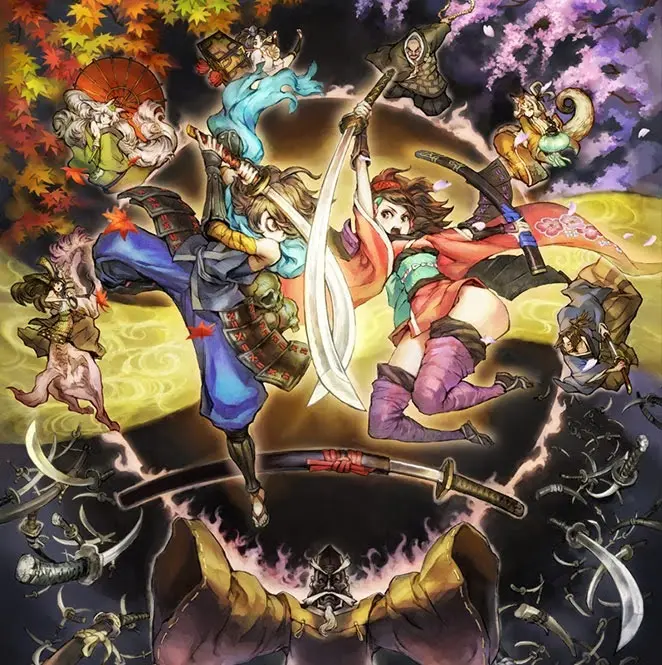
I made the Red Dragon in Dragon’s Crown, and I also made Darkova in Odin Sphere, Ippondatara in Muramasa: The Demon Blade, and so on.
The huge bosses that fill the screen were sometimes made by the background team.
I see. But once you include all that, the word “background” doesn’t begin to contain it. You’re building the coherence of the screen, the game’s readability, its impact — the very rules of the space.
Nishimura:
Perhaps so. What was good about joining Vanillaware was that I really did get to make all sorts of things.
Not just backgrounds, but UI, effects, bosses, movies. Precisely because it’s a small company, you have to do everything. That suited me.
And you held the lead of the background team all the way through Dragon’s Crown.
Nishimura:
I was allowed to be the lead through Dragon’s Crown, and after that I made a point of handing the lead over to my juniors. Whether or not you hold the lead changes your motivation enormously.
It’s better to experience it at least once, and it leads to growth. So I increasingly left it to others and moved into a supporting role myself.
And it’s around there that you start moving toward “making your own game.”
Nishimura:
That’s right. Though the desire to become a director had been with me for a long time. I made an adventure book back in elementary school, and even in my Capcom days I’d go and pitch proposals to my boss. The urge to make games was always there.
Akuryōtō no Hihō: The Taste of a Short, Successful Sprint
Before we get to Witch of the Dark Castle, there was Akuryōtō no Hihō, made as a bonus for Dragon’s Crown Pro. How did that come about?
(Akuryōtō no Hihō — literally “The Treasure of the Demon Island,” a gamebook created as a bonus for Dragon’s Crown Pro.)
Nishimura:
Atlus came to us wanting to attach a bonus. I was suddenly called into that meeting and asked, “Nishimura, what’ll you do?”
Dragon’s Crown is fantasy, and I’d made an adventure book back in elementary school. If we were going to make some kind of bonus without being able to spare much manpower, I thought a gamebook — something one person could make — would be a good fit. It pairs well with both tabletop RPGs (TRPGs) and Dragon’s Crown. It has that good old retro flavor, too.
When I floated it to Kamitani on the spot, Atlus said, “Sounds good,” too, and it came together as “Let’s go in that direction, then.”
And then, afterward, Kamitani said to me, “Nishimura — you’re actually going to do it?!” (laughs).
Wait… (laughs).
Nishimura:
Maybe he’d assumed I would turn it down with a “There’s no way I can make a bonus like that.” But I’d already taken it as settled, and frankly, I’d gone and found it interesting.
By that point, my head had already started moving on its own. Even after I’d left my seat, my mind kept racing ahead in that direction. So — let’s just do it.
How long was the development period?
Nishimura:
It might have been less than four months. Onishi, a Vanillaware programmer, was incredible and put it together in a flash. My ideas kept flowing, too, and it was mostly finished in three or four months. Not counting debugging.
That’s an incredible sense of speed.
Nishimura:
And that felt really good. “If I can make this much in such a short time, maybe this suits me,” I thought. That success carried through to where I am now.
Except this time, Witch of the Dark Castle ended up taking six years (laughs).
Nishimura:
That’s right (laughs). I started out thinking I could make it in a short time, then got too particular about it, and it took six years.
In a sense, it’s a “Vanillaware thing” — but I really do feel I’ve inherited that bloodline, and deeply so.